
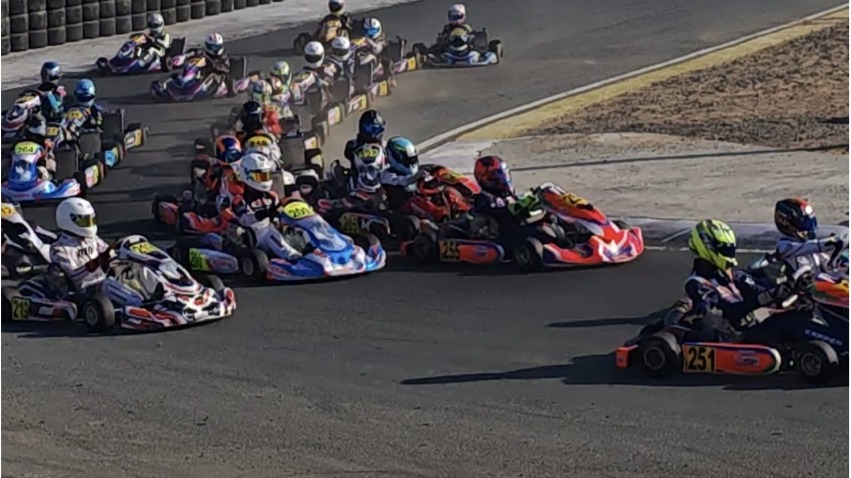
When and how to move from Dubai or Sharjah to Italy or the UK — and what a realistic karting career path for a young driver really looks like.
How to build a karting driver's career from grassroots to top international circuits like Lonato and PFi — lessons from 30 years of motorsport coaching.
How do you turn this small kid into a serious driver – maybe even a professional one one day?
At the Sharjah kart track I filmed a clip: drivers flying through the fast section, a huge cloud of sand behind them like a snowplough. The helmet covered in dust, radiator full of sand, tyres more yellow than black.
And right there a question hit me: does it really make sense to build the career of a future top-level karting driver on tracks like this? And if it does – when is the moment to move to Italy or England?
This text is my honest, practical attempt to answer that – without fairy tales and without marketing talk.
What does “building a career” in karting really mean?
Before we talk about Sharjah, Italy and England, we need to be clear what “building a career” actually is.
For me, a kart driver’s career stands on three main pillars:
1. Driving skill
- driving technique
- feeling for grip
- mental strength and focus
2. The environment they learn in
- tracks
- team
- coach
- quality of practice
- level of competition
3. Planning and decisions over the years
- when to change class
- when to move to a stronger championship
- when to move to another country
If one of these three fails, talent is easily wasted. If you line up all three in a smart way – even “the kid from the desert” can fully fight with “the kid from Lonato”.
Desert tracks (Dubai, Sharjah…) – great school or dead end?
What’s good about tracks like Sharjah?
At Sharjah kart track you get a few things that are really good for development:
Changing grip
Sand on the circuit means conditions are always shifting. The kid has to listen to the kart, drive smoothly with hands and pedals, react when the rear steps out.
Heat and physical base
35–45°C in a suit and helmet is serious work. A child who learns to drive in those conditions builds strong physical endurance.
Less pressure
Grids are smaller, atmosphere is less “factory style”. It’s easier for the child to build confidence and learn without feeling like every weekend is a world championship.
For the first years (Bambino, first Mini steps), this is very valuable.
What’s the problem if you stay there too long?
There is one big trap:
Less depth of competition
You often have three good drivers in a class – compared to 30–40 very strong ones in Italy or the UK.
Sand limits learning at the top level
To develop very fine technique and set-up work, you need a clean track with stable grip. On a sandy track it’s hard to compare set-up changes properly and hunt for the last 0.1 s.
Layout and reference
Top Italian and British tracks (Lonato, Sarno, Franciacorta, PFi, Whilton Mill…) are the reference for FIA, WSK and BKC. Later, the biggest races in the world are held there. If you grow up only on “exotic” layouts, it takes more time to adapt when you finally arrive in Europe.
Conclusion: The UAE and similar tracks are great to start and to win your first races. But if the goal is to be among the best in the world, that cannot be the only school.
When is it time to step up to Europe?
Instead of thinking only in classes (Bambino, Mini, Junior…), it’s smarter to think in age and development phases.
Phase 1: Foundations (about 5–7 years old)
Main goals:
- learn basic driving technique
- learn habits in the pits
- learn start procedure
- learn respect on track
- build a love for driving – without stress and “you must be a champion” pressure
Where to drive?
- local series: UAE, home championship, small national cups
- desert tracks like Sharjah are more than good enough (actually, great) for this phase
The point is not to fly to Italy or England every two weeks. The point is that the child enjoys driving and builds good basics.
Phase 2: First real step up (about 7–9 years old)
This is where things start to change.
If the child has been winning or running at the front locally for a while, and it all starts to feel “too easy”, you have to ask:
“What more will they learn if they spend another year on the same tracks against the same drivers?”
What to do in this phase?
You can still be based in the UAE or your home country, but:
- organise 2–4 serious race weekends in Europe per year, for example:
- Mini/Micro events in Italy (national cups, smaller WSK weekends, international trophies)
- or British events (a British Kart Championship round, or a strong club race at PFi, Whilton Mill, Rowrah…)
The goal is not to immediately win trophies. The goals are to:
- see where your child really stands,
- get used to different grip, tyres, weather and culture,
- meet teams and coaches at a higher level.
Phase 3: The big decision (about 9–12 years old)
This is the key period for the career.
By then the child should:
- have a lot of hours in the Mini class,
- have at least a few European weekends behind them,
- have raced against stronger competition.
If at European events they are not completely lost, manage to get on the pace and you clearly see potential, then comes the big question:
“Are we ready to change our life so that our base is in Italy or England?”
At this age, Mini/OK-J becomes a serious school for the F4/FIA path. If you stay too long in a weaker championship, the years disappear very fast.
Phase 4: Pro karting (12–15+ years)
If the real ambition is to go towards F4, FRECA and later Formula 3/2, then karting at this stage has to be:
- OK/OK-J or KZ2 in strong series
- WSK, Champions of the Future, FIA Euro/World, strong national programmes
At this point, it doesn’t make sense to live in a bubble of a light local championship. Either you are in the centre of serious karting (Italy plus strong European races) – or you’re almost out of the game.
Italy or England – which “league” is better?
Both are top level, but the “school” is slightly different.
Italy – the “university” of world karting
Italy is:
- home to the biggest teams and manufacturers (Tony Kart, CRG, Birel, Parolin, etc.),
- host of WSK, FIA European and World events,
- full of tracks that are a world standard (Lonato, Franciacorta, Sarno, Cremona…).
What you get there:
- reference grip and layouts that transfer straight to FIA/WSK level,
- constant strong competition,
- teams used to preparing drivers for F4.
If you want your child to learn how to drive in “world-level” conditions, Italy is the natural choice.
UK – the best national filter
The UK has:
- the official British Kart Championship under Motorsport UK,
- many strong club series and tracks (PFi, Whilton Mill, Rowrah, Larkhall…),
- a tradition of crazy fights in rain, cold and changing conditions.
What you get there:
- a great school of racecraft – often with less grip and more aggressive, but smart, fights,
- top training for driving in the wet or on a drying track,
- very tough drivers mentally – if you survive Britain, no weather will scare you.
For some drivers the ideal is: base in the UK plus occasional trips to Italy. For others: base in Italy plus some races in the UK. Realistically, most families will choose one main base and use the other from time to time.
Does it make sense to stay in Sharjah forever?
Speaking honestly and without sugar-coating:
Yes – it makes sense to start there. The child will learn control, discipline and physical strength.
No – it doesn’t make sense to stay there for the whole Mini/Junior phase if the goal is to be at the top of FIA/WSK.
A healthy plan could look like this:
- 5–7 years – local series (UAE or your country), focus on basics and fun.
- 7–9 years – base still local, but 2–4 European weekends per year (Italy/UK).
- 9–12 years – move the base to Italy or the UK if the child clearly shows potential.
- 12+ years – full focus on OK/OK-J/KZ2 in top series.
By then, those old videos from Sharjah with the cloud of sand behind the kart become a nice memory and proof: “We didn’t start in perfect conditions – but we knew when to make the next step.”
Five simple rules for parents and coaches
These are the rules I wish someone had given me on a small piece of paper when I started:
1. Win your first races at home
The child should first learn to win in a small world before you throw them into a big one.
2. When the local league becomes “too easy”, go out
If the kid wins all the time without real effort, they don’t need another season of that. They need a challenge.
3. Don’t skip classes just for ego
It’s better to be a top driver in the right age class than “average” in a class that’s too big a jump.
4. Italy and the UK are tools, not trophies
The goal is the driver’s development, not stickers on the van. If you don’t have the budget and time to be there regularly, it’s better to mix smartly chosen smaller races.
5. The most important investment is a decision at the right time
A wrong decision for one season (moving up too early or too late) can cost more than any new engine or chassis.
Conclusion
The video from Sharjah, with the cloud of sand behind the kart, became a symbol for me of where we start and how important it is to know when and where to move on.
Desert tracks can be an excellent starting point. But the career of a top karting driver almost always leads through Italian tracks where WSK and FIA races take place, and/or British tracks where tough character is built in the rain.
It doesn’t matter where you start. What matters is noticing the moment when it’s time to raise the level – class, championship or country – and then making that step bravely, but with a clear head.