
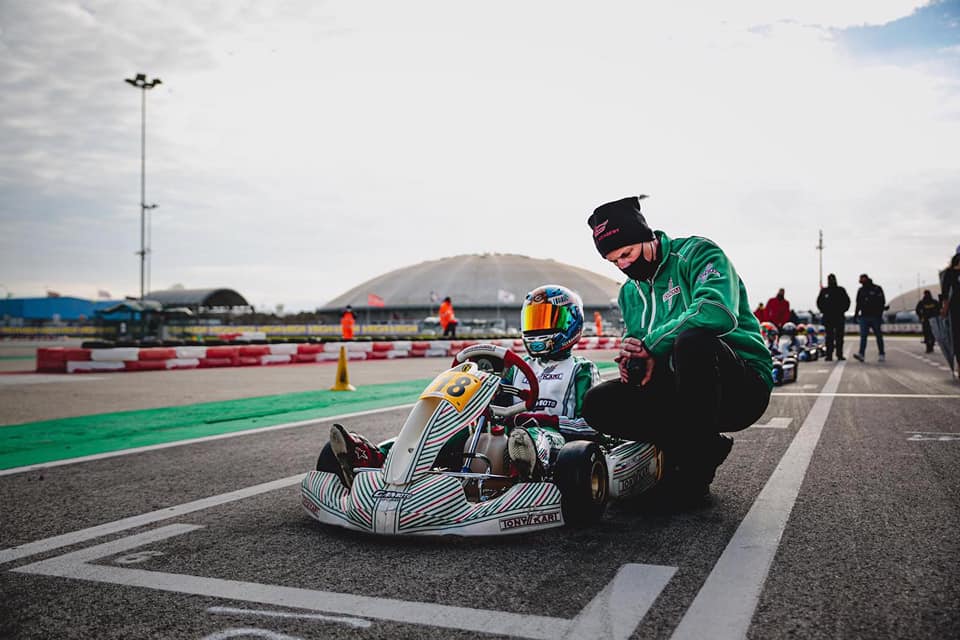
Karting is brutal because it constantly forces you to separate talent from equipment, a random “fast lap,” and a good day. Talent isn’t “how fast someone is when everything clicks,” but how they reach that speed—and how often they can repeat it.
In practice, talent in karting is most often visible through six dimensions.
1) Speed That Comes Early (Without Perfect Conditions)
A talented driver gets “close” before they should, considering their seat time.
- Red flag (false talent): one brutal lap, and everything else is inconsistent.
2) Learning Curve
The biggest giveaway: how quickly the driver “gets” the track, the tyre, the grip—and how quickly they stop repeating the same mistakes.
3) Adaptation (Setup / Conditions / Someone Else’s Kart)
When you change pressures, axle, carburation, or the temperature shifts—talent doesn’t fall apart. It adapts.
4) Efficiency
Quiet hands, controlled rotation, minimal sliding. A fast lap looks “boring.”
5) Racecraft and Mindset
Talent without a head = an early exit from the race. Real talent shows in traffic, on the start, under pressure.
6) Technical Feedback That Helps
Not “the kart is trash,” but what it does on entry / mid-corner / exit and under braking.
Case Studies: What Was Visible Already in Karting
Ayrton Senna: “Feel” and Cleanliness on Grip
Karting facts: Senna was South American karting champion (1977) and twice runner-up in the Karting World Championship (1979, 1980). He also won the Brazilian Karting Championship in 1978 (documented on senna.com).
Sources: Ayrton Senna (summary) · Senna.com: 1978 Brazilian Karting Championship
What does that say about talent?
Not a “flash,” but a peak at the highest level across multiple seasons. Karting at that level is a “pure fight”—that’s where grip control + mental stability show.
How to test this with your driver (practical):
- Session 1: colder tyres / less grip → watch who stays clean and fast.
- Session 2: traffic + pressure → who doesn’t lose it and do something stupid.
Question:
Have you ever had a driver who was faster when the grip was worse? What did they do differently?
Lewis Hamilton: Speed + Adaptation + “Racing IQ” from a Young Age
Karting facts (important and verifiable): Hamilton collected national titles early, and a key point was 2000 when he won the Karting World Cup (Formula A) and became European Champion (Formula A). The well-known Autosport Awards scene is also referenced, where as a ten-year-old he approached Ron Dennis; Dennis wrote “Phone me in nine years…”. Motorsport.com has confirmation via a statement from his father Anthony.
Sources: FIA Karting: Lewis Hamilton · Motorsport.com: Anthony Hamilton quote
What is the “talent signal”?
When someone wins in karting at a level where everything is millimeters and nerves—and it carries into a career—it’s usually a combination of: learns fast + adapts fast + knows how to race.
How to translate that into your paddock:
- Give the driver an A/B test: same day, two pressure sets or two axles.
- Measure: how quickly they find the limit, and whether they’re fast immediately or only after you explain everything.
Question:
What’s a bigger indicator of talent: 1 lap or 10 laps within 0.1–0.2?
Max Verstappen: Adaptation and Racecraft as a Natural Habitat
Karting facts: Verstappen started karting very early (around age 4) and already through child/mini classes collected national titles (Belgium/Netherlands) before breaking through toward higher international levels.
Source: Formula1.com: Max Verstappen bio
What is the “talent signal”?
- speed in traffic (they don’t lose 0.5s just because someone is ahead),
- decisions (when to attack, when to wait, where to set up the overtake).
This is the part of talent many people ignore, but in karting it’s huge: talent for racing, not just for one lap.
Practical test:
- Intentionally put them into traffic. Watch: do they overtake cleanly and with a plan, or emotionally?
Question:
Who has a “bigger talent”: the one who’s top in quali, or the one who’s a monster in traffic?
Fernando Alonso: Technical Mind and “Mechanic’s” Precision
Karting facts: Alonso cemented his reputation by winning the CIK-FIA 5 Continents Juniors Cup (1996, Genk). His karting CV shows continuous work and serious results across multiple years.
Source: FIA Karting: Fernando Alonso
What is the “talent signal”?
- feels what the kart does through the phases of the corner,
- gives feedback that “unlocks” the setup,
- is often fast even when the kart isn’t perfect, because they drive smart.
Practical (for coaches/parents):
Ask the driver three concrete questions after a session:
- where do you lose the front end?
- where does the rear break away?
- is the problem under braking, release, or throttle?
If they can answer precisely and repeatedly—that’s a serious signal.
Question:
Can a “technical mind” be learned, or is it part of talent?
Michael Schumacher: “Mechanical Empathy” + Work Ethic That Kills the Competition
Karting facts: Schumacher won the German Junior Kart Championship (1984 and 1985), and FIA karting profiles and official resources record his early karting rise.
Sources: FIA Karting: Michael Schumacher · Michael-Schumacher.de: early career record
What is the “talent signal”?
Here’s an important lesson: part of “talent” looks like work—but not all work is equal. The best have a rare combination:
- obsessive repetition,
- the ability to extract conclusions from repetition,
- and driving that preserves the tyre and rhythm.
Practical test:
Give a task: “The goal is 8 laps at the same rhythm without sliding.”
Who can do that—has “material” for big things.
Question:
Was Schumacher more “talent” or more “work”? (And why?)
Bonus Example: Charles Leclerc and “Talent Under Equal Conditions”
Leclerc in karting had results including winning the KF3 World Cup (Sarno 2011), and an important point: the Academy Trophy is often mentioned as a format that brings conditions closer to “equal equipment.” It’s a useful reminder: when conditions are more equal, talent and mindset come to the surface.
Sources: FIA Karting: 2011 history (KF3 World Cup) · FIA Karting: Academy Trophy note
Mini Poll for Parents, Drivers, and Coaches
The best indicator of talent is:
- 1 lap (raw pace)
- 10 laps in rhythm (consistency)
- speed in traffic (racecraft)
- adaptation to changes (setup/conditions)
- feedback and technical understanding
Question for coaches/parents:
What is your indicator that someone is NOT as talented as they look?
Question for drivers:
What one thing accelerated your progress the most: video, telemetry, coach, driving with stronger drivers, or mental work?