
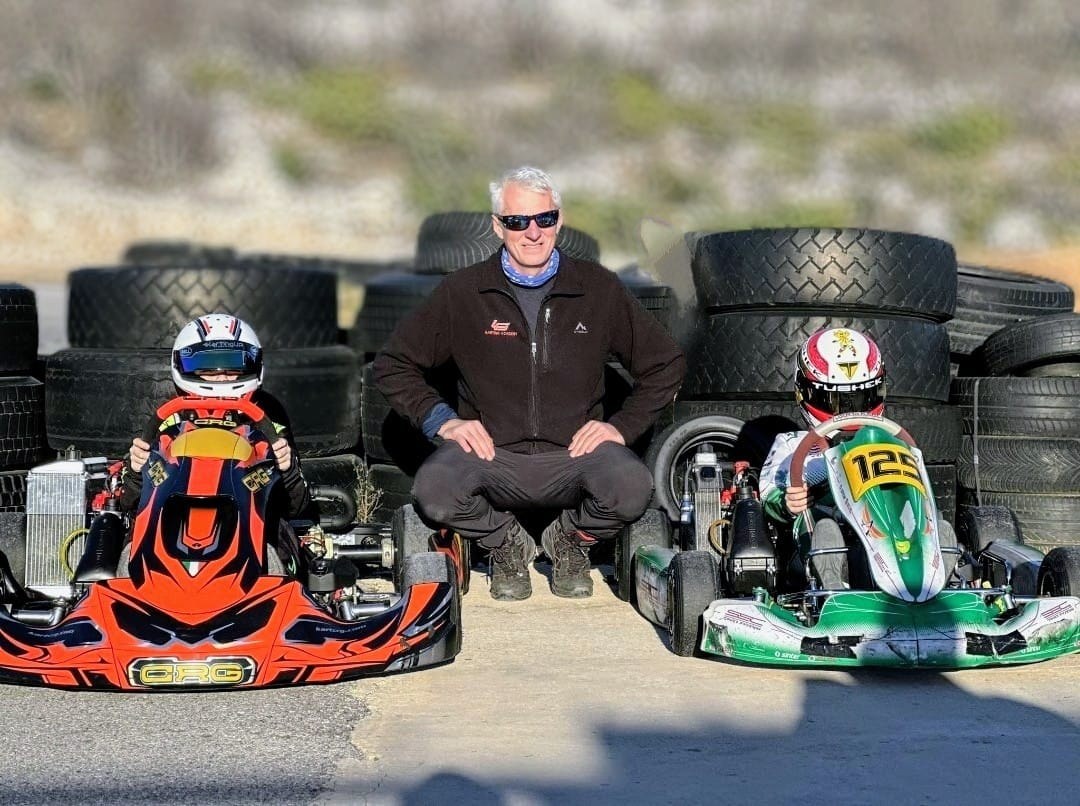
In karting, the biggest results are not built in the first big leaps, but in the phase of fine polishing—and that is exactly when many people break continuity, change the coach or team, and end up confused, slower, and without real direction.
In the first training phases, progress is often spectacular. Lap times drop quickly, the driving looks “cleaner,” and the child gains confidence. That’s logical: in that phase you correct big, obvious mistakes—line choice, basic braking, vision, corner entry and exit, body position, hands.
But then comes the part that decides the career.
Progress is no longer “one second per lap.” Progress moves into something that, to an outsider, often looks like repetition—and that’s exactly where cooperation most often breaks, coaches get changed, or even the team gets changed.
Karting does not forgive those breaks. Not because the child is “bad,” but because in karting everything comes down to one thing: continuity of correct technique under pressure.
Fast Progress Is Not the Same as Lasting Progress
There are two types of progress:
- Fast progress – you fix big mistakes and you get a big jump.
- Lasting progress – you polish details until the driver becomes consistently fast in all conditions.
In the second phase, progress is:
- slower (for example 0.05–0.15 s per segment, not 1 s per lap)
- less “visible” to the eye
- focused on repeatability, not on one perfect lap
And karting does not reward “one perfect lap.” Karting rewards the driver who can be fast:
- when the tyres drop off
- when it’s crowded
- when race stress arrives
- when they must defend and attack without losing rhythm
That’s why top-level training can look simple from the outside. In reality, it’s the most precise part of the job.
Why a Driver with More Coaches and Mentors Often Doesn’t Progress
One of the biggest brakes on a young driver’s development is not a lack of talent—it’s mixed messages.
When a driver changes coaches, mentors, or teams, they usually get:
- different reference points
- a different philosophy of braking and corner entry
- different priorities (“brake later,” “release earlier,” “carry more speed,” “be safer”)
- a different communication style
The result is not “more knowledge.” The result is often confusion.
The young driver then starts thinking too much and driving less instinctively. Instead of automating technique, on every run they ask themselves: “What is correct now?”
And in karting, where decisions are measured in fractions of a second, that’s a recipe for stagnation.
Even worse: every change of system pushes the driver one step back, because it:
- interrupts the automation process
- re-opens old habits
- breaks the development rhythm
- shifts the focus from “building” to “searching”
That’s why serious progress almost always comes from one source: clear direction, one methodology, continuous work.
Repetition Isn’t “The Same.” Repetition Is Polishing a Diamond.
When a technique is first learned, it is fragile. It works sometimes, when everything is ideal.
When the technique is polished, it works always.
That’s the difference between a driver who:
- can do one fast lap
and a driver who:
- can do 10 fast laps in a row, without a drop in pace
In that phase you “repeat,” but you’re not repeating the content—you’re repeating the quality.
The error tolerance becomes small: centimeters, meters, fractions of a second. Exactly there the difference is created that you later see in results across the whole season.
Why Many People Rely on “More Driving” or Equipment
When progress slows down, the natural reaction is:
“Let’s drive more.” or “Let’s invest in tyres/engine.”
But without a technical base and consistency, extra driving only strengthens what the driver already does—including mistakes. And equipment can help, but it cannot replace:
- technique
- error control
- mental stability
- pace under pressure
In practice it ends like this: spending goes up, and the result stays the same.
My Way of Working: 1-on-1, Clear Direction, Measurable Progress
I work one-on-one because I want full control of the process: the driver gets clear instructions, the same language, the same system, and continuous correction over time. That is the fastest path to lasting progress—without noise, without “try this/try that,” without wandering.
My obligation to the driver is simple: measurable progress.
Not “by feel,” not “maybe,” but through concrete indicators that decide results in karting:
- lap consistency (not only best lap)
- stability of reference points
- corner-exit quality and rhythm
- behavior in traffic and under pressure
When those things are built systematically, the stopwatch follows by itself—and most importantly: it stays.
Conclusion: Karting Is a Short Sport—So It Must Not Be Done Randomly
Karting has short windows. Age 7–14 is key because that’s when the foundations are built that later decide how far a driver can go.
The most expensive mistake is not a wrong corner.
The most expensive mistake is a lost season because of a change of direction, a change of coach, a change of team—and constant resetting of the process.
If you want a driver to develop seriously, they need:
- one system
- one direction
- continuity
- expert, individual work
That’s not “more training.” That’s smarter training.
Invitation
If you want serious, structured development and 1-on-1 work with a clear plan and measurable progress, reach out. Karting does not forgive wandering—but it rewards high-quality continuity.