
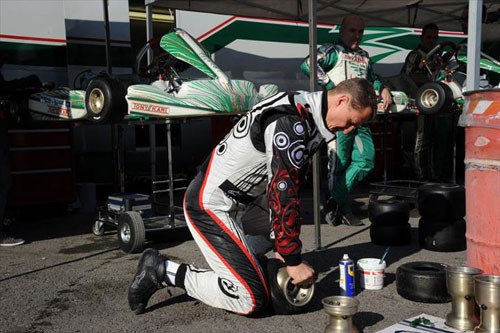
Why even the best Formula 1 drivers cannot just jump into an OK or KZ kart and win — and what it would actually take to be competitive at that level.
Why is it that a driver who can handle 1,000+ hp in Formula 1 can jump into a kart and not automatically win?
This text is not written to put karting “above” Formula racing or to criticise F1 drivers. The goal is to explain, in a simple and realistic way:
- what “top-level international karting” actually means today
- why even an active F1 driver would struggle to win straight away
- what an F1 driver would really need to do to become competitive at that level
What does “top-level karting” mean today?
When we say “top karting”, we mainly mean the modern FIA categories:
- OK-Junior (OKJ) — 12–14 years
- OK — senior direct-drive class from 14+
- KZ and KZ2 — gearbox (shifter) classes, often called the “F1 of karting” because of the performance and complexity
In these classes you find the FIA Karting World Championships and FIA Karting European Championships.
Alongside the FIA calendar there is a full unofficial “world tour” with series like WSK Super Master, WSK Euro Series, WSK Final Cup and other top international races and official tests.
A typical top driver in OK/OKJ/KZ/KZ2:
- races around 10 months per year
- has factory or semi-factory support
- works with engineers, data analysts, mental coaches and physical trainers
That is the world an F1 driver is stepping into if he “comes back to karting”.
Michael Schumacher’s return: home track, top team… no win
After his fourth F1 World Championship in 2001, Michael Schumacher decided to race in the final round of the Formula Super A World Championship (the top kart class at that time) in Kerpen – his home circuit.
He raced with Tony Kart and lined up against the very best kart drivers in the world at that moment.
From analyses of that weekend:
- in the first final he came up from deeper in the field before a technical problem
- in the second final he produced a huge comeback and finished 2nd
- the race wins went to established karting specialists
So even with his own track, a top factory team and his exceptional talent, Schumacher did not win.
This does not make him less great. If anything, it shows how insanely strong the level of top karting is.
Rubens Barrichello in KZ: World Championship vs. karting specialists
Fast forward to Kristianstad 2016, FIA World Championship in KZ.
Rubens Barrichello – F1 race winner, hugely experienced – came back to karting and finished 24th in the final. The world title went to professional kart driver Paolo De Conto.
Different driver, different era, same message: today’s top karting is its own professional sport with its own elite – even for drivers who have already raced in F1.
Karting is not just a “small formula car”
All F1 drivers started in karts. So why is it so hard to “just jump back in”?
Because the way a kart works is fundamentally different from a Formula car.
1. Vehicle mechanics and chassis behaviour
A kart has no suspension or dampers in the usual sense — the chassis itself flexes and acts as the spring.
It reacts brutally to small changes in track width, ride height, tyre pressure and seat position.
In KZ (gearbox), the driver works the clutch, gearbox and brake under very high deceleration and acceleration, and mistakes in timing are punished immediately.
An F1 driver arrives with instincts built around downforce, aero balance and a very different weight distribution and response on entry and exit. He cannot just copy those habits into OK or KZ. He has to rebuild his feel around a rigid chassis that flexes, slides and “talks” in a different way.
2. Braking and rotation: one clean, violent movement
At the top level in OK and KZ, the driving style is very specific:
- short, extremely hard braking
- precise trail braking that rotates the chassis in one clean movement
- a settled kart in the middle of the corner
- minimal steering corrections on exit
The concept sounds similar to single-seaters, but the operating window of a kart is much narrower. Enter a corner a few km/h too fast, the kart slides, the rear “binds up” and you lose time — and there is no aerodynamic downforce to save you in fast sections.
You must hit that window lap after lap, in a pack of 30+ karts, often with contact and changing grip.
3. Tyres and the “performance window”
At FIA World and European events, tyres have a very precise window in temperature, pressure and number of laps.
Drivers who live in karts all year know exactly when they switch on, how much they can push on each lap and when they are about to “fall off the cliff”.
An F1 driver dropping into karting for a few days has to rediscover that feel from zero, against rivals who have been tuning their tyre sense every weekend for years.
Operational reality: training volume and season rhythm
Top kart drivers in OK/OKJ/KZ/KZ2 run a calendar with FIA, WSK and other internationals, often 10+ major events per year, and add testing days between races on multiple circuits. The track is their office.
An active F1 driver has a full F1 race calendar, simulator work, team and sponsor duties and personal training. If he returns to karting, realistically he can only do a limited number of test days and a few big events. He rarely matches the specific seat time of the best kart drivers.
It’s not about talent. It’s pure specific preparation: the kart guys simply work in that environment much more.
Racecraft, psychology and the “F1 name”
At world-level kart events, the top drivers know every bump and camber on the circuit, how the grip builds through the weekend and how the track changes with rubber and temperature.
They are used to racing in huge fields of 25–36 karts where you are attacked on entry, pushed in the middle and crossed over on exit.
For an F1 driver coming back, every camera is on him. Every overtake or mistake becomes a story. Some rivals will try extra hard to beat “the F1 guy”. When he was a kid in karting, nobody cared. When he comes back, everyone cares — and that is an extra mental load.
What would an F1 driver need to do to be truly competitive?
Forget PR appearances for one weekend. From a pure sporting perspective, a realistic minimum programme for an F1 driver aiming at victory in an FIA World or European OK/KZ event would look something like this:
1. Join a top team
Teams with a proven record of winning at that level: Tony Kart, KR, CRG, Birel ART, Parolin, Sodi and similar factories or top satellite teams.
2. Build a real test plan
Roughly 5–10 serious test days on 2–3 different circuits, always with a reference team-mate from the current top 10 in that class.
The goal is to learn the tyres, the kart, the braking style and the race pace — not just turn laps alone.
3. Do a preparation race first
Before the main FIA event, enter at least one strong race, for example in WSK or similar level.
Targets there: understand the rhythm of a top karting weekend, go through practice, timed qualifying, heats and final, manage starts with 30+ karts and handle tyre management and racecraft in the middle of the pack.
The job is not to win immediately, but to collect information.
4. Set step-by-step goals
Realistic progression might look like this:
- first race: reach the final and show competitive pace at some point in the weekend
- next races: aim for consistent top-10
- only once the pace is there: target podium or victory
In other words, the F1 driver would need to come back as a part-time (almost full-time) karting driver with a proper programme, not as a guest star.
So why is it so difficult?
Formula 1 drivers are extremely talented, technically very strong and originally shaped by karting.
But today’s top karting — OK, OKJ, KZ and KZ2 in FIA/WSK — is a highly specialised sport with its own elite group of professionals. It demands a specific driving style, deep understanding of chassis flex and tyres, and constant, focused work in that exact environment.
The stories of Michael Schumacher and Rubens Barrichello show this clearly: they came back to world-level karting, did well, but did not simply dominate. That does not make them weaker drivers. It tells us how high the bar is in modern top-level karting – and how much respect that level deserves.
Why this matters for coaches and drivers
For coaches, national-level drivers and serious hobby racers, understanding this gap helps to judge their own level realistically, plan a smart step from national to international classes and respect karting not only as a “junior step to F4”, but as a demanding motorsport discipline in its own right.
If an F1 champion cannot just walk in and win, then a top karting driver is not “just a kid in a toy car” — and any driver who wants to reach that level needs more than just talent. They need a clear plan, the right environment and a lot of specific work.