
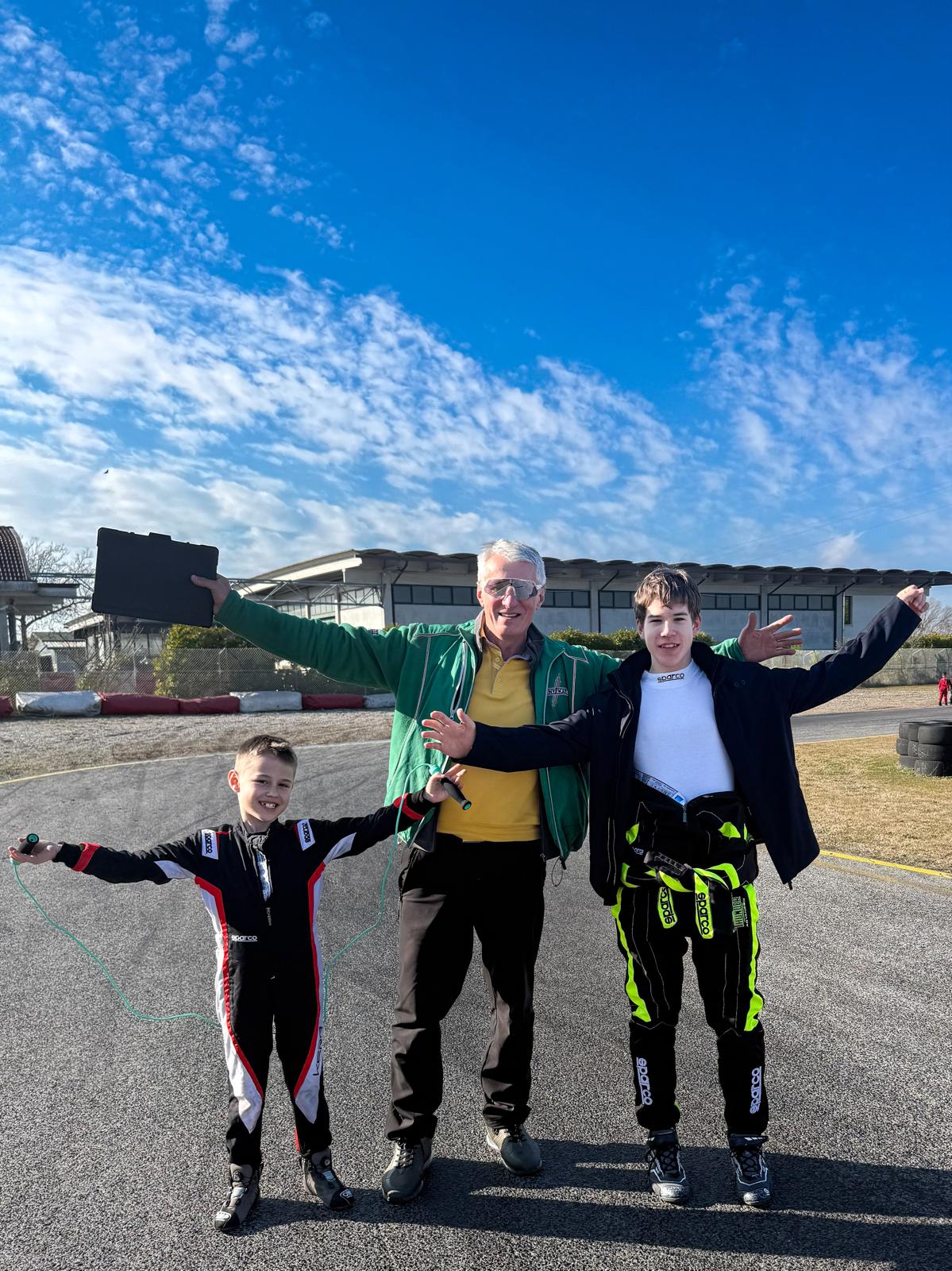
Karting is often seen as speed, adrenaline, and a fight for thousandths of a second. But from a coach’s perspective, karting is much more than that. It’s a sport that teaches young people how to perform under pressure, how to build discipline, how to deal with failure, and how to develop confidence that doesn’t depend on a single race. In other words: karting is a school of character.
At the Azzurra circuit, I see this from session to session—especially through my two young drivers, Marko (8) and Filip (16). Two different stories, different ages, different personalities, but the same core idea: a small step forward every day.
1) Karting teaches the process: results are an outcome, not your identity
In karting, you quickly learn an important lesson: you don’t always get what you “deserve.” You can do an excellent job and still end up with a poor result because of a mechanical issue, an incident, or the wrong situation on track. That’s why the focus must be on what you can control: preparation, focus, routine, technique, and analysis.
This is where the Japanese philosophy of Kaizen fits perfectly—being better today than you were yesterday. In karting, you don’t find a tenth of a second by magic. You earn it through repeating the small things: a better corner entry, calmer hands, smarter judgment, better timing.
A real example: Marko is only 8, but you can already see how driven he is by winning. He comes from judo—he’s had several matches and won a bronze medal—and he brings that “fighter mindset” into karting. Last year, in the Micro Max class, he finished 3rd in the national championship. My job isn’t just to “make him faster,” but to channel that ambition into the process: not chasing results at any cost, but learning how to win through routine, composure, and high-quality work.
2) Karting builds responsibility: no shortcuts, no excuses
There’s no room for excuses in karting. The stopwatch tells the truth immediately. A young driver learns early that they must:
- show up prepared
- listen and follow the plan
- take care of equipment and safety
- take responsibility for their decisions
That’s pure gold for personal development. Because a child who learns responsibility and strong work habits through sport often transfers them to school, family life, and other goals.
A real example: Filip (16) comes from handball. He plays right wing, competes in the national championship with his team, and is already used to teamwork. What stands out most is his discipline—you can tell he understands what training means and what it means to be part of a system. His handball coach also develops him by placing him in the pivot position, forcing him to think differently and adapt. That ability to adapt is priceless in karting—because karting constantly demands that a driver change and grow, not just “drive the same way every time.”
3) Decisions under pressure: karting trains the mind as much as the hands
Karting is fast. You’re close to others. Everything happens in a second. A young driver is constantly making decisions:
- Do I attack now or wait?
- Where is the risk limit?
- How do I respond after a mistake?
- How do I stay calm when things aren’t going well?
That’s mental toughness training. In life, the winners are the people who can stay stable in chaos—and karting is controlled chaos.
What it looks like in training: With Marko, that pressure often shows up emotionally—he wants to “prove it” immediately, and sometimes it’s hard for him to accept that he needs patience. With Filip, you see the other side—discipline helps him receive instructions more calmly and work systematically. Both learn the same lesson: stay composed, learn first, then increase the pace.
4) Don’t compare yourself to others: compare yourself to who you were yesterday
Karting is a sport where comparisons can destroy confidence, because conditions are rarely equal: experience, budget, testing, equipment, set-up, tires… That’s why one of the most important messages for young drivers is:
Don’t watch others. Watch your progress.
If today your technique is better, your focus is stronger, or your reaction to mistakes has improved—that’s a win. That’s Kaizen.
In practice: It’s natural for Marko to focus on “who is first” because he comes from a combat sport. Filip has learned that team and process produce results. My job is to teach Marko the power of process, and to help Filip build the right patience to attack when the moment is right. That’s the beauty of karting: through the same sport, you develop different people in different ways.
5) “It doesn’t always go to plan”—and that’s part of growth
Mechanical issues, mistakes, a bad day, an incident… all of that is part of karting. And that’s where character is built. Young drivers must learn that a plan is not a guarantee—but their response is their responsibility.
You can’t control everything. But you can control your response.
Karting teaches kids not to quit after a bad day, but to analyze, take the lesson, and come back stronger. That may be the most valuable skill sport can give.
Conclusion: karting is sport, but it’s also upbringing
Karting is powerful because it builds:
- discipline and work habits
- responsibility and independence
- mental toughness under pressure
- a healthy relationship with winning and losing
- a habit of learning and continuous improvement
That’s why my mission is clear: that my drivers—whether they’re 8 or 16—use karting to build confidence and a growth mindset that will serve them for life.