
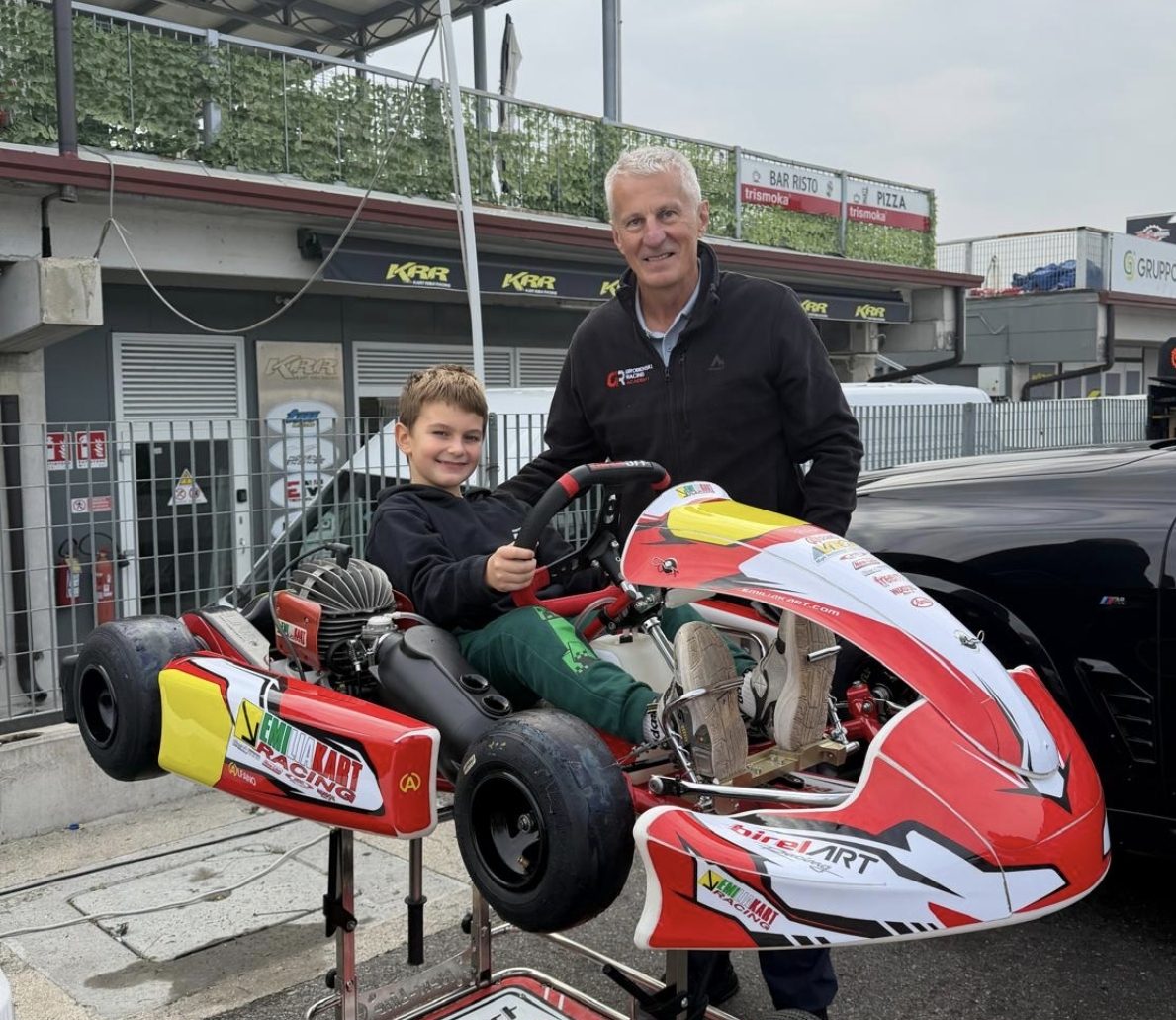
A Weekend at Franciacorta
Luka Stepić is seven years old, and this season he raced in the Croatian Championship in the 50 Baby class. On the weekend of 31 October and 1 November he trained with me at the Franciacorta circuit in Italy, in a group of more than 30 twelve-year-old drivers.
He drove a Birel Easykart 60, which for him is a big jump in speed. The track is very fast and demanding, with elevation changes, and on top of that it rained.
When the track was drying, we put slicks on and he handled it well. He spun once, but he came back.
At the end of the first day he came to me overjoyed:
On the second day he did several. At the end of the two days he said the sentence that is the reason I'm writing this:
What I Was Watching as a Coach
With a seven-year-old, lap times are not the first thing I look at. I look at how he learns. Luka listens carefully to instructions, and you only have to tell him something once.
Everything interests him, he asks questions, and he works hard. After every session he cleans his kart and takes good care of his gear. His fitness is at an enviable level, because he also trains in swimming.
At that age, these are the things that build an athlete: joy, curiosity, work habits, and the courage to go back out on track after a mistake. What he said at the end of the weekend shows he got the most important thing.
He loves what he does.
Hype and Polished Results
On social media today I see a different picture. Seven- and eight-year-olds are presented as future Formula 1 champions. Results get polished and dressed up, and often they are only half true.
The fastest lap in free practice becomes "fastest on track." A win in a class of four drivers becomes a "big win." The child reads that, and so does everyone around him.
Posts like that are mostly written by parents, with good intentions. But in my experience, that kind of hype does more harm than good.
The International Olympic Committee (IOC) also warns that youth sport has become too focused on adults and the media. Young athletes are often seen as a product, and the line between objectivity and sensationalism is thin (IOC, 2015).
The Burden Kids Carry
A seven-year-old doesn't understand marketing. He only understands that something is expected of him. When everyone around him talks about Formula 1, every bad session becomes a small failure.
This is not just my opinion. The IOC warns that young athletes are more and more exposed to unrealistic demands and expectations, coming from themselves, from coaches and from parents (IOC, 2015).
The consequences are psychological overload, burnout and quitting the sport. High expectations and criticism from parents can also develop unhealthy perfectionism in a child.
A study of 80 Italian boys aged 11 to 14 who play football showed that the kids feel too much pressure from their parents, and too little praise and understanding. And that is exactly what they wanted: less pressure, more praise and understanding (Bonavolontà et al., 2021).
When Results Start to Matter
In my experience, results in karting really start to matter in the junior and senior categories, from around age 13 or 14. That's when you see who has built the foundations.
Sport science says something similar. According to the model of Canadian researcher Jean Côté, until about age 13 children try different sports, and the focus is on fun. Only between 13 and 15 does an athlete narrow down to one or two sports, and results become more important (Garland et al., 2023).
The IOC states that systems that pick talent based on children's results have had limited success. Few young athletes make it to elite sport, and growth and maturation can change the picture completely (IOC, 2015).
So Why Do I Post Videos Too?
Someone will ask why I post Luka's video then. The difference is in what we celebrate. I don't celebrate the result or the promise of a future champion. I celebrate the effort, the joy, and what the child learned.
Luka's sentence, "I'd stay here 30 more days," is worth more to me than any trophy at that age. A post like that doesn't put a weight on the child's back. It shows him that his effort is worth something.
What Parents Can Do
Parents are the most important people in a child's sport, and without them there is no karting. So this is not a complaint. It's a suggestion:
- Praise effort, courage and progress, not position and lap time.
- Don't compare your child with other children, on track or on social media.
- If you post, write the truth, and write about what your child learned.
- Let them do other sports too. For Luka, swimming also gives him fitness for karting.
- After a race, ask your child if they enjoyed it and what they learned, not what place they finished.
The IOC recommends the same: a broader definition of success, a challenging and enjoyable environment focused on learning, and a variety of sports in childhood (IOC, 2015).
My Message
The most important thing is that the child learns. You don't put expectations of results in front of kids. If a boy like that decides one day to go into motorsport, it can only be his own decision, without sensational hype that he'll be a future F1 champion.
My job as a coach is to raise a real athlete and a healthy young man. There is time for results later, in the junior and senior categories. If the child loves what he does, he'll have the strength and the will to fight for them.
— Marijan Grobenski, Karting, Physical and Mental Performance Coach
Sources
- Bergeron M. F. et al. (2015). International Olympic Committee consensus statement on youth athletic development. British Journal of Sports Medicine, 49(13), 843–851. doi.org/10.1136/bjsports-2015-094962 · free PDF
- Garland W. J., Smith K. L., Dixon J. C., Horton S. (2023). Developmental activities of elite junior hockey players: an analysis of early sport specialization. Frontiers in Sports and Active Living, 5:1253007. Describes Côté's model of athlete development. doi.org/10.3389/fspor.2023.1253007