
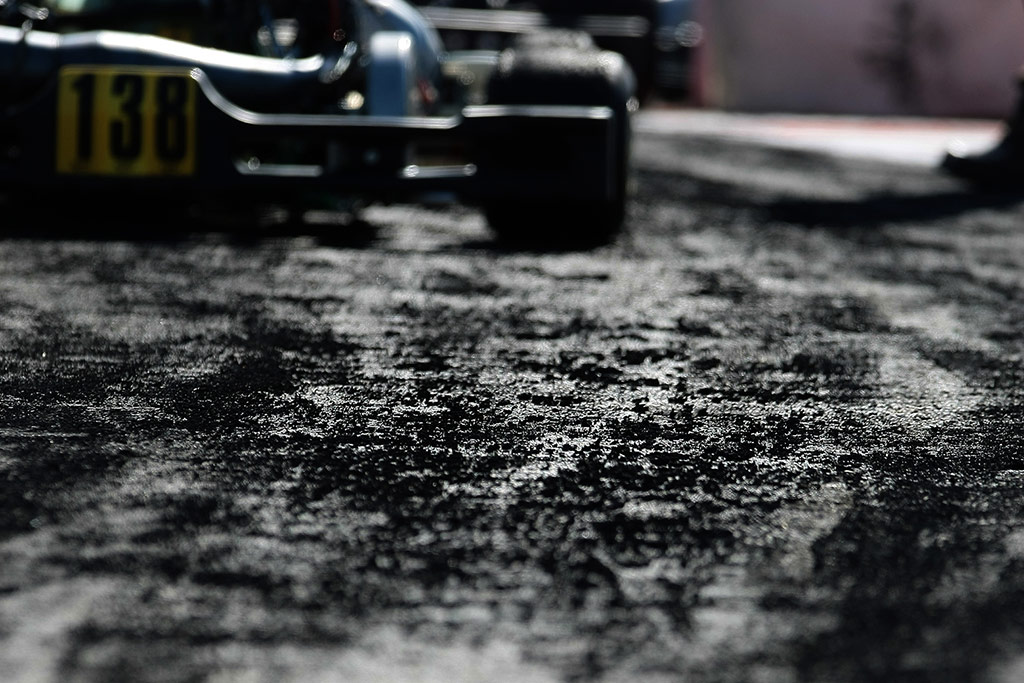
Many people assume that more rubber on the track automatically means more speed. In reality, it does not work that way. A rubbered-in track does not reward every driver equally — it quickly reveals who truly understands driving, who can feel changes in grip, and who knows how to adapt technique to what the track demands in that moment.
In lower-grip conditions, a driver can still hide some weaknesses through aggression and quick reactions. On a rubbered-in track, that usually stops working. Excess steering input, over-attacking corner entry, poor brake release, and abrupt throttle application all cost lap time immediately. At that point, the kart no longer rewards force. It rewards precision.
That is why a rubbered-in track is not just a technical challenge for the kart. It is also a very clear test of driver quality.
The Problem Is Not Always the Setup
In karting, the first reaction is often: the kart needs to be freed up. Sometimes that is true, but it is only part of the picture.
Yes, when grip increases, the kart can become too stuck to the asphalt, lose freedom in the middle of the corner, and start choking the exit. In those situations, setup absolutely has to be part of the solution.
But just as often, the real problem is not the kart. It is the driver continuing to drive as though the track were still slippery. He tries to force the kart to rotate, carries too much steering lock, overloads the front tyre, and ends up destroying the grip the track is actually offering.
That is why serious driver coaching cannot stop at the sentence, "We need to change the setup." The first step is understanding the real cause of the lost pace. Is the kart outside its working window, or has the driver failed to adapt his technique? Without that distinction, time is very easily wasted in the wrong area.
What Really Has to Change on a Rubbered-In Track
When grip increases, the driver has to become calmer, cleaner, and more disciplined. The specific adjustments are:
- Corner entry must be more controlled
- Brake release must be more precise
- Steering input must be quieter
- Throttle application must be smoother
- The racing line must become smarter, not simply more aggressive
A driver who does not understand this will usually say the kart "doesn't go," "doesn't turn," "binds up," or "has no exit." Sometimes that is true. Sometimes it is not. This is exactly where a coach must be able to separate symptom from cause.
My job is not simply to tell a driver that he needs to be faster. My job is to identify why he is not fast and explain exactly what needs to change in his driving.
Speed Is Not the Same as Adaptability
Many young drivers can be quick when conditions are stable and familiar. But races are not won only in ideal conditions. Real progress shows when the track evolves, when grip increases, when the balance of the kart changes, and when the driver has to find a new solution in a short amount of time.
That is when you see who is only repeating a learned lap and who truly understands how to drive.
A driver who wants to improve must learn how to read the track. He must feel when he can no longer force the kart. He must recognise when the racing line is no longer the same as it was an hour earlier. He must know how to stay fast even when conditions are no longer comfortable.
That does not happen by accident. It is trained.
My Approach to Driver Coaching
When I work with drivers, I am not interested in a single fast lap on its own. I want to know whether the driver understands why that lap was fast — and whether he can repeat it when the conditions change.
That is why my coaching is focused not only on fundamental driving technique, but also on adaptability. A driver has to learn:
- The difference between a problem that comes from setup and a problem that comes from his own inputs
- How changing grip affects corner entry, mid-corner behaviour, and corner exit
- When to calm the hands, when to extend the flow through the corner, and when to stop searching for speed through aggression
This kind of work does not just produce a faster driver. It produces a driver who understands what he is doing.
And that makes a major difference. Because a driver who does not understand conditions will always depend on everything being ideal. A driver who does understand conditions can remain competitive even when the track is no longer the same as it was in the morning.
Why This Matters to Parents
Parents often see only the lap time on the screen or the final result after a session. But behind that result there is much more than talent alone. If a driver does not learn how to adapt to grip, line, and kart behaviour, progress will stall very quickly. He may show speed from time to time, but he will not be consistent. And without consistency, there is no serious long-term development.
That is why the right coach matters. Not a coach who looks only at the outcome, but one who understands the process. A coach who can:
- Explain why a driver slows down when the track rubbers in
- Distinguish driver error from a technical setup issue
- Guide a driver through changing conditions, not only through ideal ones
My role is not just to give advice between two runs. My role is to develop a driver who can think, feel, and adapt like a competitor.
Conclusion: Real Coaching Begins When Conditions Change
A rubbered-in track reveals the truth very quickly. At that point, courage and effort are no longer enough. What matters is feel, technique, discipline, and understanding.
Setup matters. The driver matters. But most important of all is knowing what needs to change, and when.
That is where a coach makes the difference. Because the goal is not for a driver to be fast only when everything suits him. The goal is for him to be fast even when conditions change.
That is where real coaching begins.
Related Reading
- Speed Is Not Enough: How Mindset and Confidence Decide Results in Karting
- Real Karting Practice — Plan, Rhythm, Clarity
- Karting as a School of Character
- The Most Expensive Mistake in Karting: Changing Coaches Too Soon
- Neurofeedback training for karting drivers
If your driver struggles when the track rubbers in, contact me at marijan.grobensky@gmail.com